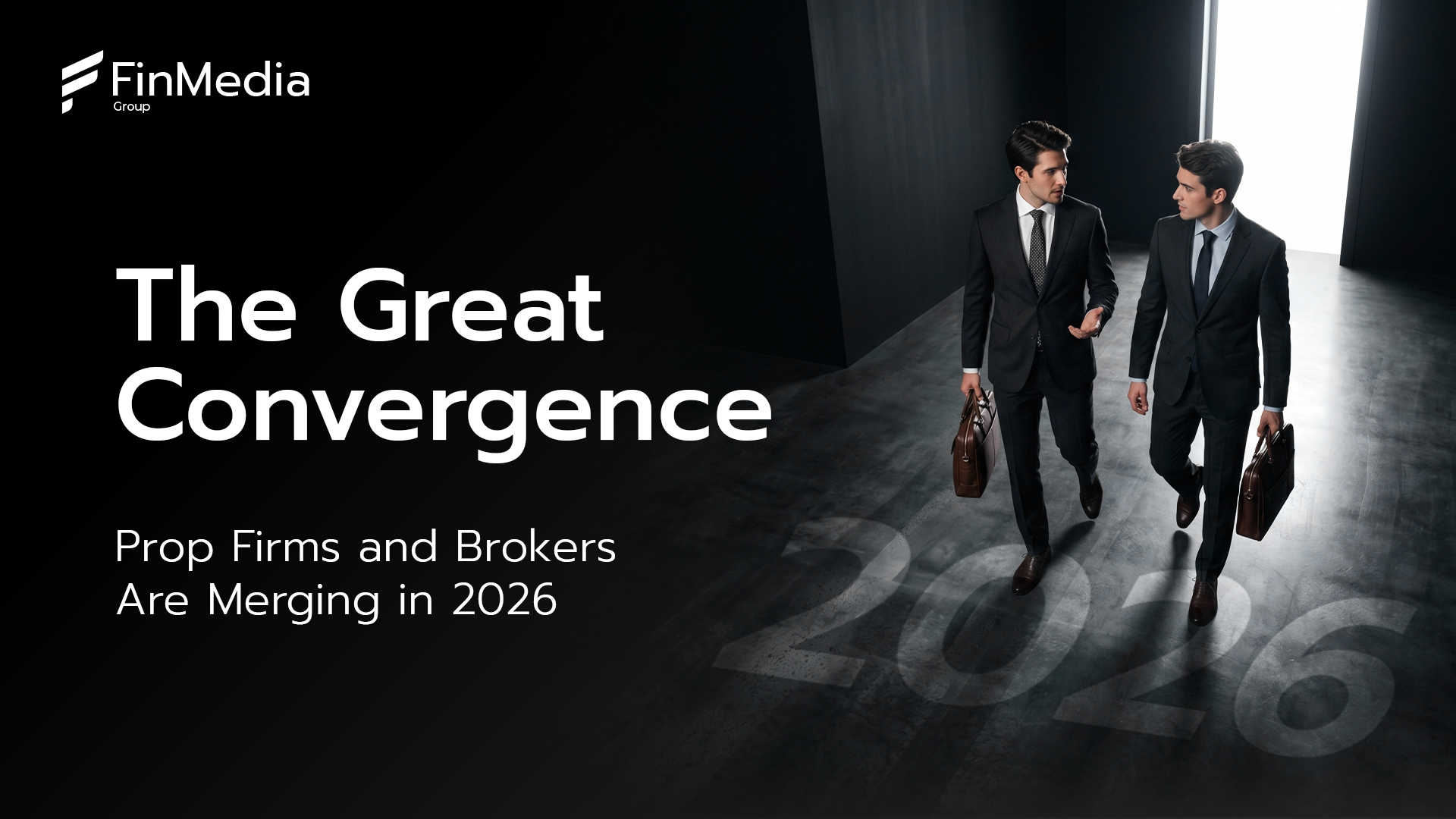
The line between prop trading firms and brokers is disappearing.
What used to be two separate models is now becoming one integrated system.
Brokers provided access to markets
Prop firms provided access to capital
In 2026, the industry is moving toward something else:
Integrated trading ecosystems.
It is a structural change in how the retail trading industry operates.
The Old Model No Longer Holds
For years, the roles were clearly defined.
Brokers focused on:
- Execution
- Liquidity
- Infrastructure
- Regulation
Prop firms focused on:
- Trader acquisition
- Evaluation models
- Funded accounts
Each operated in its own lane.
But both models had limitations.
Brokers struggled with:
- Rising acquisition costs
- Low retention
- Heavy competition on spreads
Prop firms struggled with:
- Dependency on third-party infrastructure
- Payout pressure
- Regulatory uncertainty
- Trust issues
So both sides started moving toward each other.
Prop Firms Are Becoming Brokers
One of the most important developments in recent years is the shift of prop firms into brokerage infrastructure.
The most visible example is FTMO acquiring OANDA.
This was not just an acquisition. It was a strategic move.
Prop firms are no longer positioning themselves as marketing-driven challenge platforms.
They are positioned as fully integrated financial entities.
This shift is also happening at the infrastructure level.
Firms like FundedNext, FundingPips, and City Traders Imperium are building or aligning closely with broker entities.
The objective is clear.
Control the environment in which traders operate.
Owning a brokerage is not just about expansion. It is about removing dependency.
By owning or launching a brokerage, prop firms gain:
- Control over execution and pricing
- Direct access to trading flow
- Platform licensing stability (MT4/MT5, cTrader)
- Better margin control
- A regulatory foundation for long-term growth
Instead of relying on external brokers, they internalize the system.
This shifts their position from the edge of the value chain to the center of it.
Brokers Are Moving Into Prop Trading
At the same time, brokers are entering the prop space.
They recognize that prop trading is one of the most effective ways to acquire and retain traders.
- Retention improves when traders engage with structured challenges.
- New revenue streams are created through challenge fees.
- Customer acquisition becomes more efficient, especially in emerging markets
In many cases, prop has become:
A more efficient acquisition funnel than traditional brokerage accounts
The Funnel Is Becoming the Business
The structure is evolving into a closed system.
At the top, traders enter through challenges.
In the middle, they engage with funded accounts.
At the bottom, they transition into brokerage clients.
Some firms are already building this model.
Topstep, for example, has expanded into brokerage infrastructure, allowing traders to move within the same ecosystem.
Instead of losing traders after the challenge phase, companies retain them across the entire lifecycle.
The Market Is Forcing Consolidation
This shift is happening alongside a market correction. Nearly one third of prop firms disappeared between 2024 and 2025.
It was a filtering process.
Firms that relied purely on marketing or short-term monetization struggled to survive.
Firms that invested in infrastructure, compliance, and execution remained.
The implication is clear.
The barrier to entry has increased. The standard has changed.
Infrastructure Is Replacing Branding
In earlier cycles, growth was driven by visibility: strong branding, aggressive promotions, and affiliate networks were enough to scale.
That phase is ending.
The current phase is infrastructure-driven.
Companies like FPFX Tech, Quadcode, and Spotware are investing directly into the systems that power prop trading.
This includes:
Execution systems
Platform technology
Competition infrastructure
Regional expansion
The competitive edge is shifting.
From visibility to capability
Regulation Is Accelerating the Shift
Another force behind convergence is regulation.
As prop trading becomes more visible globally, regulatory frameworks are starting to take shape.
Operating without structure is becoming increasingly difficult.
Broker ownership provides a compliance anchor, making it easier to adapt to evolving requirements
The Real Shift: Who Owns the Trader Lifecycle
Most people look at this as:
Prop Firms vs Brokers
But that is not the real story.
The real shift is:
Who owns the trader lifecycle
From:
- Discovery
- Evaluation
- Funding
- Execution
- Retention
The companies that control this entire flow will have the advantage. Because they are not just acquiring users, but they are building systems around them.
What This Means for Founders and Operators
The era of standalone models is ending.
Launching only a prop firm, or only a broker, is becoming less competitive over time.
The direction is clear:
- More integration
- More control
- More infrastructure ownership
For new entrants, this changes how businesses should be built from the start.
Not as isolated products, but as connected systems.
A More Mature Market Is Taking Shape
For traders, the outcome is largely positive.
The market is becoming more stable.
Execution quality is improving.
Payment systems are becoming more reliable.
Rules are becoming clearer.
This reflects a broader shift toward trust-based infrastructure.
The firms that remain are those that can sustain operations, not just attract attention.
They are the ones with:
- Reliable payouts
- Solid infrastructure
- Clear rules
- Sustainable models
This defines the next phase of the industry.
The Future Is Integrated
As we move further into 2026, the industry is no longer divided. It is consolidating into integrated systems.
Prop firms are becoming brokers.
Brokers are becoming prop firms.
This is no longer a market of separate players.
It is becoming a market of integrated platforms.
For companies operating in this space, the direction is clear.
Adapt to the integrated structure
Or compete against those who already have
At FinMedia Group, this is exactly the shift we are tracking as we continue building data-driven media ecosystems, performance-led distribution, and high-intent audience channels across the global trading industry.
Be Present. Be Relevant.